
Physics Newsletter December#2
- Bhavya Goel
- Dec 30, 2024
- 3 min read
Physics Pulse: Physics Newsletter
By: Bhavya Goel - Researcher

"Negative time" observed in new quantum experiments, surprising scientists

Recent experiments by researchers from the University of Toronto have observed a phenomenon called "negative time," where intervals measured during light-matter interactions appear to be less than zero. While this might sound like science fiction, the researchers clarify it doesn’t involve time travel or objects moving backward in time. Instead, it highlights peculiar quantum behaviors where photons, behaving as both particles and waves, interact with matter in ways that defy classical expectations. Their study focused on how atoms absorb and emit light, revealing intervals that challenge conventional notions of time but remain consistent with the laws of physics.
The findings, published on the arXiv preprint server, have sparked debate and curiosity among physicists. While some argue that the term “negative time” might over dramatize the results, the researchers emphasize that their data reflects real, measurable phenomena in quantum mechanics. Although practical applications are yet to emerge, this study opens doors for further exploration into the complexities of quantum processes, reinforcing how quantum physics continues to challenge and expand our understanding of reality.
Read Full Article At:
Quantum Teleportation Achieved Over Internet For First Time

Researchers in the US have successfully teleported a quantum state of light over 30 kilometers (around 18 miles) of fiber optic cable while sharing the infrastructure with regular internet traffic—a groundbreaking achievement previously deemed impossible. Unlike teleportation in science fiction, this involves transferring the quantum possibilities of an object from one location to another by entangling two objects and measuring their states simultaneously. The process, which requires shielding quantum states from interference, was made possible through techniques that minimized scattering and mixing with the high-speed internet traffic of 400 gigabits per second.
This demonstration marks a significant step toward developing quantum-connected computing networks capable of enhanced encryption, powerful sensing, and secure communications. Prem Kumar, a computing engineer from Northwestern University, emphasized the revolutionary potential of integrating quantum and classical communications over existing infrastructure. By selecting specific wavelengths, quantum states can coexist with conventional data streams, eliminating the need for specialized infrastructure. The breakthrough paves the way for a future quantum internet, offering engineers a powerful toolkit for secure and efficient connectivity across vast distances.
Read Full Article At:
Scientists are building underwater neutrino telescopes in the Mediterranean

Deploying telescopes to study neutrinos in the depths of the Mediterranean Sea is an extraordinary feat, blending physics with engineering ingenuity. The Cubic Kilometre Neutrino Telescope (KM3NeT) comprises two underwater telescopes off the coasts of Sicily and France, designed to capture fleeting high-energy neutrinos from space and atmospheric neutrinos, respectively. These telescopes, resembling underwater forests, consist of hundreds of vertical cables adorned with glass spheres housing photomultiplier tubes. These devices detect light produced when neutrinos collide with seawater. Physicists endure arduous voyages to deploy the detectors, as each campaign must be executed flawlessly due to the immense costs and challenges of underwater operations.
The Sicilian telescope explores cosmic neutrinos, while the French installation studies neutrino oscillations, akin to the IceCube observatory in Antarctica. Deploying these intricate instruments involves lowering strands to the seabed, where remotely operated vehicles guide and release them into place. Once deployed, adjustments are impossible, demanding precision and teamwork during installation. Despite the physical toll, the researchers appreciate the unique setting, balancing the challenges of deep-sea exploration with the Mediterranean’s stunning vistas. Their work pushes the boundaries of neutrino astronomy, contributing to groundbreaking discoveries about the universe’s most elusive particles.
Read Full Article At:
US ploughs $50m into sodium-ion battery development
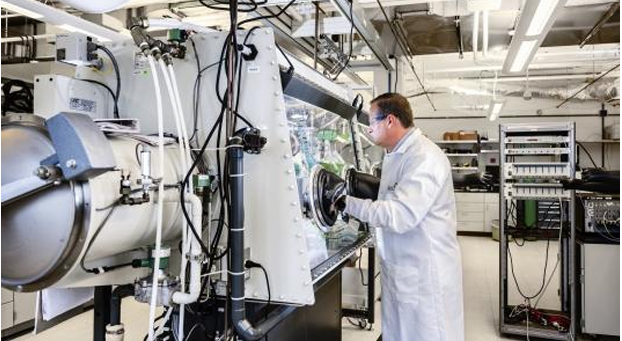
The U.S. Department of Energy (DOE) has allocated $50 million to a consortium of national laboratories and universities to accelerate the development of sodium-ion batteries, presenting a sustainable and cost-effective alternative to lithium-ion technology.
While lithium-ion batteries dominate markets like electric vehicles, smartphones, and renewable energy storage, their reliance on critical materials like lithium, cobalt, and nickel creates vulnerabilities in supply chains. Sodium, an abundant and affordable element, offers a potential solution, although sodium-ion batteries currently lag in energy density compared to their lithium-ion counterparts.
This funding will establish the Low-cost Earth-abundant Na-ion Storage (LENS) consortium, spearheaded by Argonne National Laboratory. The initiative includes five other DOElabs, such as Brookhaven and Sandia, alongside eight U.S. universities. Argonne director Paul Kearns emphasized that advancing sodium-ion technology will enhance energy security and bolster U.S. competitiveness.
The LENS consortium aims to innovate high-energy electrode materials, optimize electrolytes, and design efficient, long-lasting sodium-ion battery cells. Venkat Srinivasan, the consortium's director, highlighted the challenge of achieving and surpassing the energy density of phosphate-based lithium-ion batteries while minimizing the need for critical materials.
This development marks a significant step toward diversifying battery technologies, reducing dependencies on scarce resources, and fostering a more sustainable energy future.
Read Full Article At:


Comments